For lifecycle marketers and founders of Klaviyo brands with replenishable products
Find the lapsed customers worth winning back, and prove the lift with a holdout.
Winback Lift learns how long your customers take to reorder each product, finds who is overdue, and runs your win-back campaign against a random holdout. You see the incremental orders, revenue and gross margin per customer — not the revenue an attribution report would credit to the campaign anyway.
Request early accessComing to the Shopify App Store · free plan · paid plans from 29 USD / 30 days with a 14-day trial
The problem: attributed win-back revenue includes customers who would have come back anyway
Take a coffee brand whose buyers reorder about once a month. A win-back flow emails everyone who has not ordered for 45 days. Some of them order again, and the email tool credits those orders to the flow. But part of them would have reordered without the email: they were just late. Attribution cannot tell the two apart, so the flow can look profitable while it adds little — or it can hide a flow that really works.
The way to know is a holdout: keep a random part of the same customers out of the campaign and compare. Doing that by hand means exporting customers, splitting them at random, keeping the split frozen, excluding the holdout everywhere else and computing the difference with its uncertainty. Winback Lift does those steps for you.
The coffee brand above is an illustration, not a customer.
What we found when we researched it
- Klaviyo has its own global holdout groups, but they need at least 400,000 profiles, apply to all marketing channels and are meant to run for at least three months (Klaviyo Help Center: Getting started with global holdout groups). A brand below that size, or one that wants to test a single win-back campaign rather than all of its marketing, needs another way.
- Merchants ask how to hold out a single flow to see its incremental impact (Klaviyo Community: holdout testing for a specific flow).
- Practical guides explain that attribution is not incrementality and that a random holdout is the test (eCommerce Fastlane: how to measure email and SMS incrementality with Klaviyo).
How it works
- Import your order history. The app reads orders, products, unit costs and email consent; it changes nothing in your store.
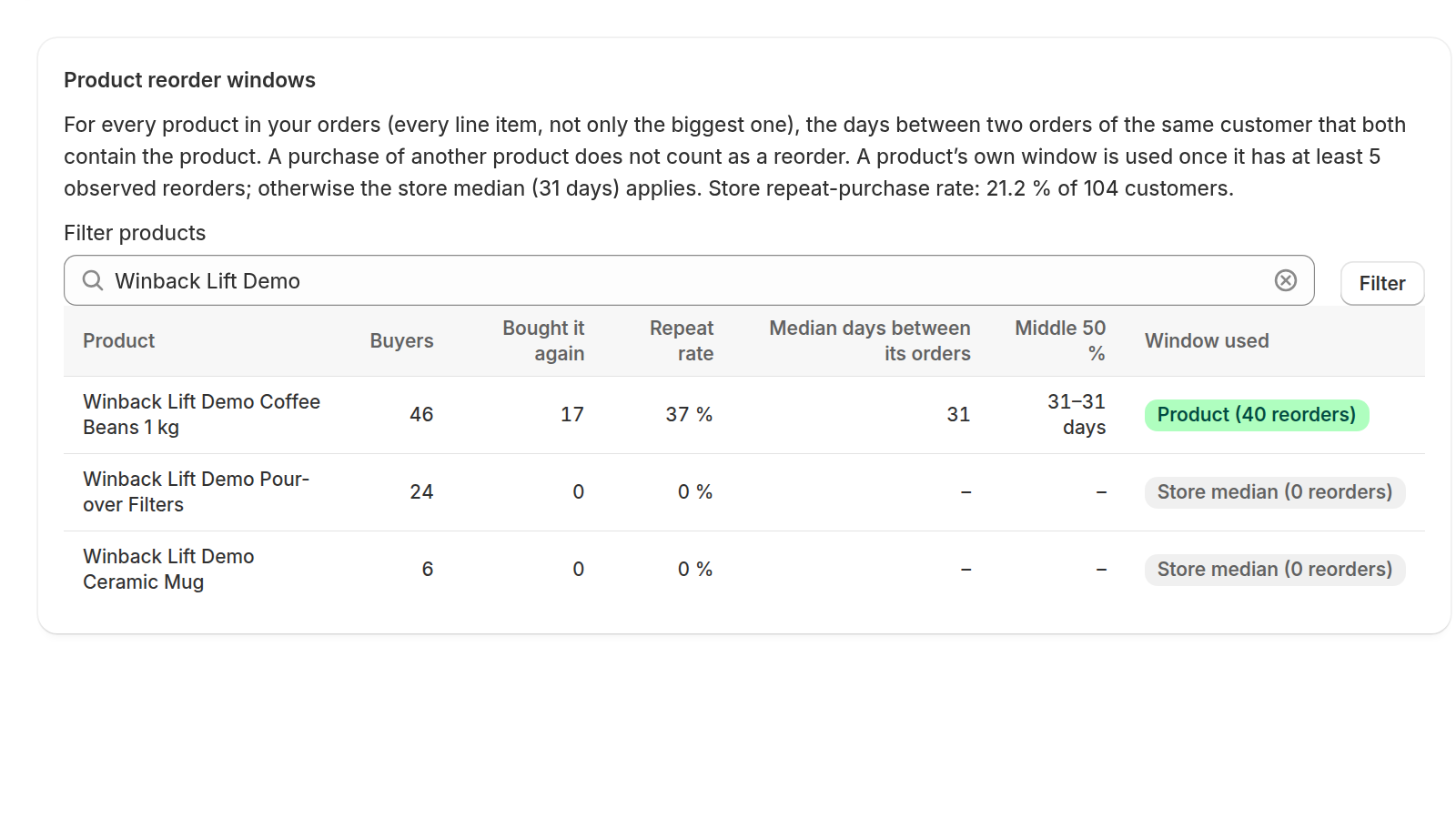
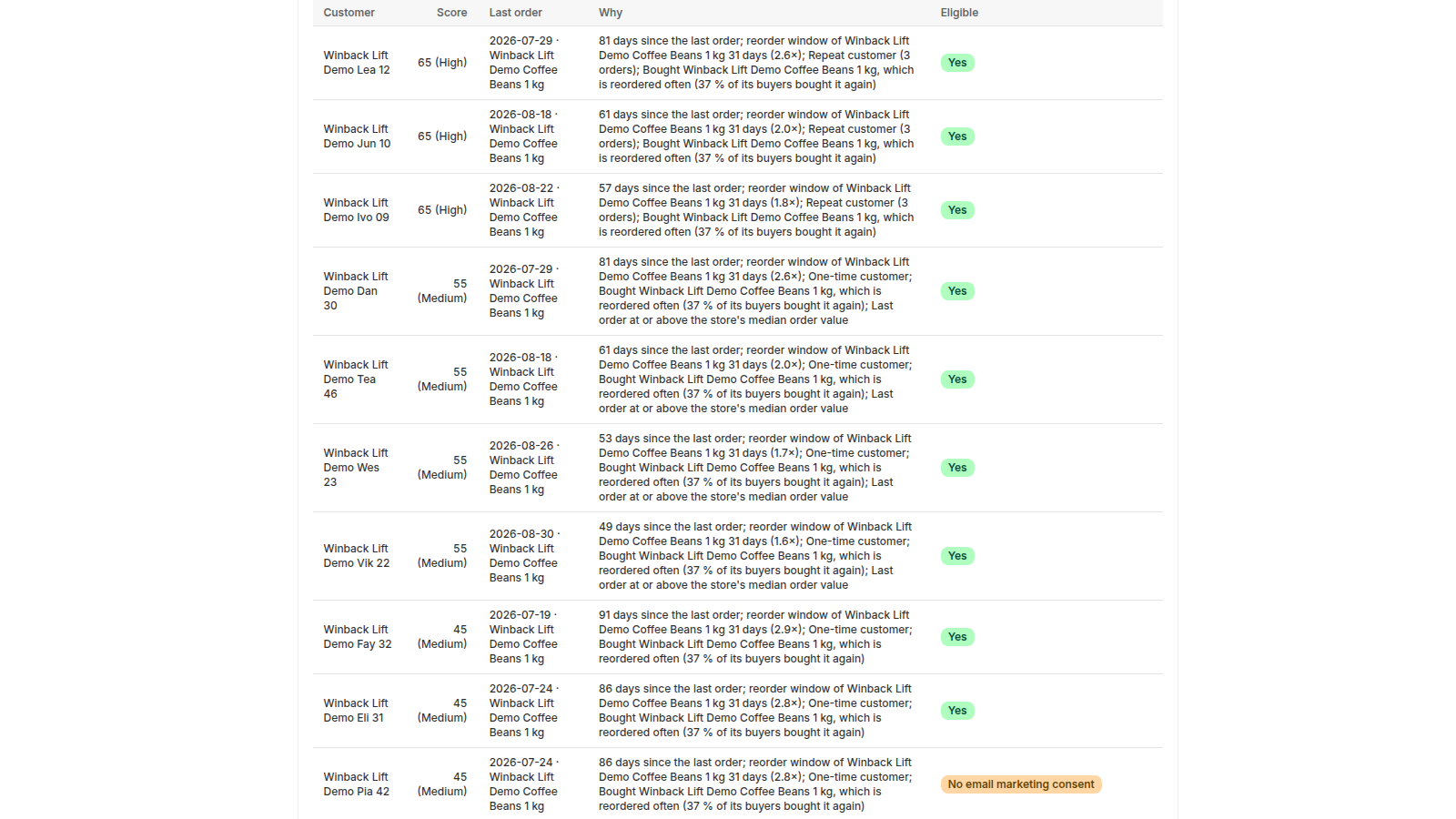
- See each product's reorder window and who is due, overdue or long lapsed, with a transparent score and the reasons.
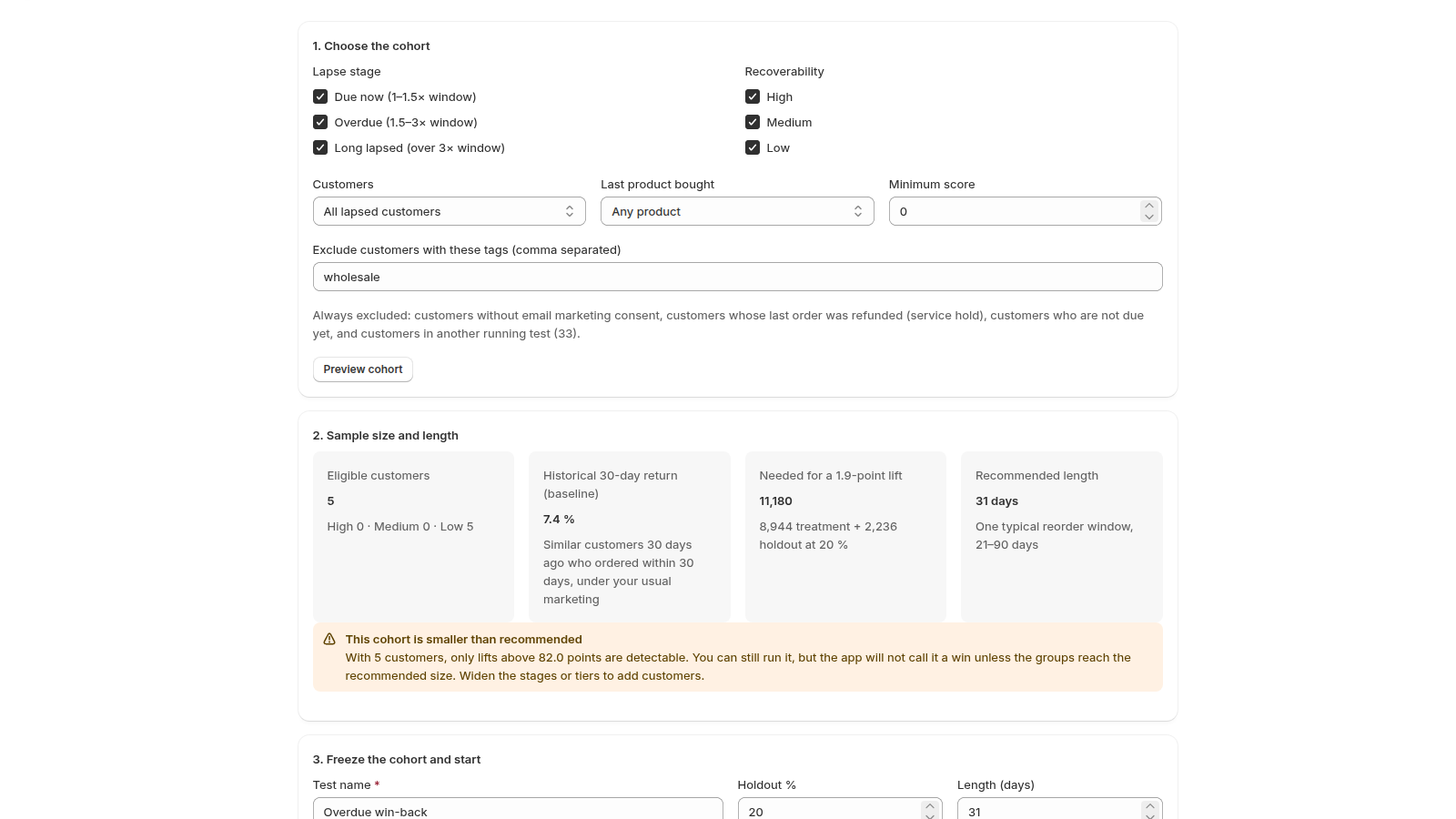
- Freeze a test cohort. The app re-checks consent, splits customers at random into treatment and holdout, and tells you how many customers and days a reliable answer needs.
- Send the groups to Klaviyo lists or Shopify Flow (or download them), run your win-back campaign on the treatment, and keep the holdout out of other campaigns.
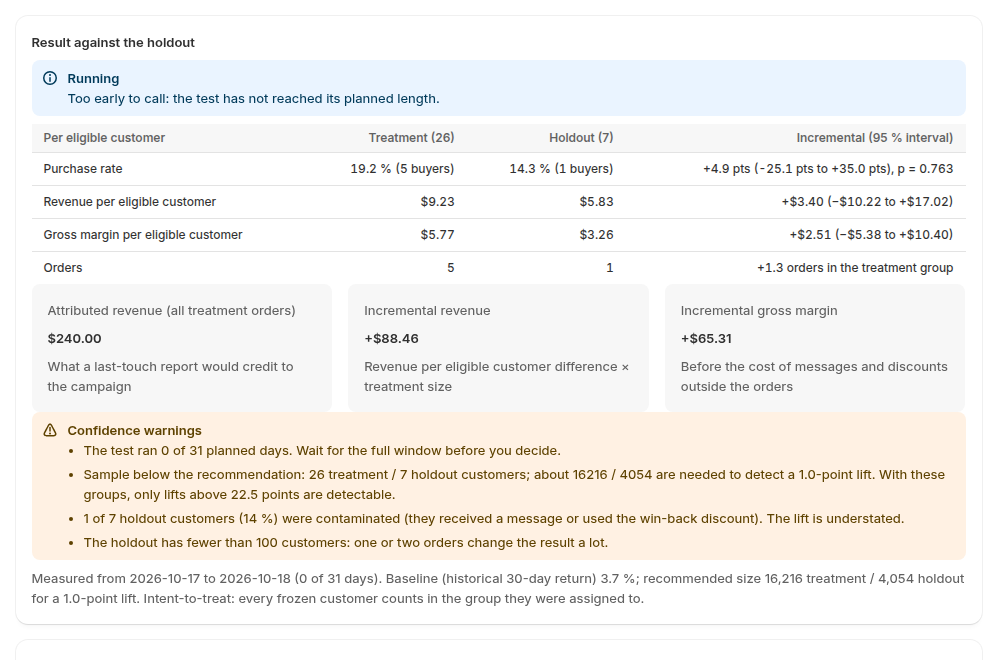
- Read the lift: incremental purchase rate, revenue and gross margin per customer with confidence intervals, contamination checks, and a clear verdict only when the test is long and large enough.
Honest limits
- Small cohorts are often inconclusive. The app says so and does not call a win until the groups reach the recommended size and the planned length.
- Winback Lift does not send messages and never changes marketing consent: your email tool sends, and only customers who are subscribed in Shopify are included.
- The holdout only works if you exclude it from your other campaigns and flows for the test length. The app checks Klaviyo messages and win-back discount codes, but it cannot see other tools.
- The historical return figures include your usual marketing; only the holdout measures what a campaign adds.
Pricing
| Free | 1 running test, cohorts up to 500 customers |
|---|---|
| Growth — 29 USD / 30 days | 5 running tests, cohorts up to 5,000 customers, 14-day free trial |
| Scale — 79 USD / 30 days | Unlimited running tests, cohorts up to 50,000 customers, 14-day free trial |
Billed through Shopify. No fee on your revenue.
Request early access Questions: help@elektraset.com · Setup guide